
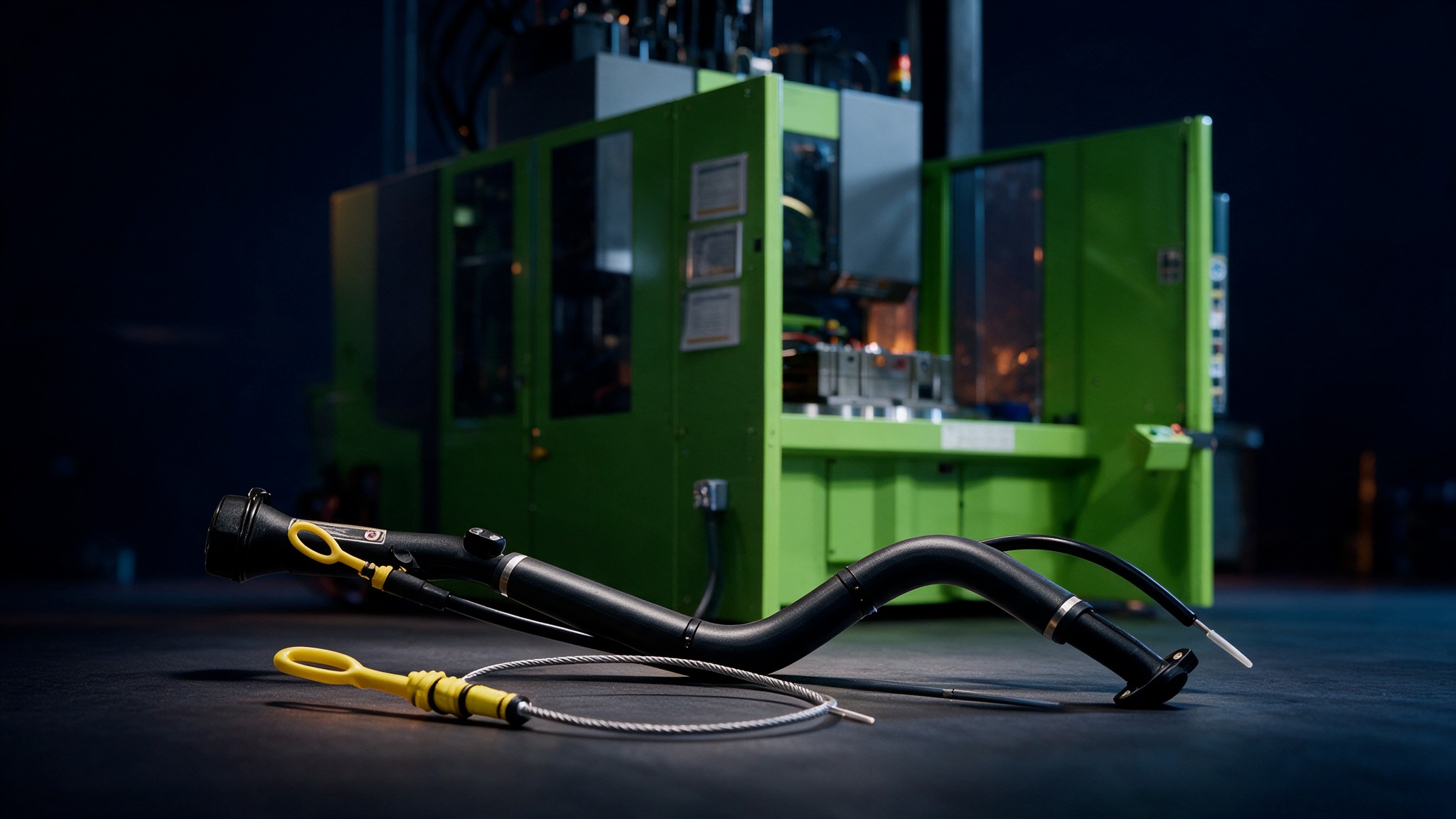
 Custom Dipsticks, Formed Oil Fill Tubes, and Complete Assemblies Built, Sealed, and Tested Under One Roof
RL Hudson designs and builds custom dipstick assemblies for original equipment manufacturers (OEMs). Each assembly includes the molded dipstick, a fill tube formed to the engine’s routing, and the seals between them, and ships as a single part number. Instead of handing an OEM a standard part to design around, we start from the engine and build the dipstick to fit it. For engineers, that means easier routing and a sealed assembly. For procurement teams, it means one accountable supplier delivering what the program needs.
Challenge: What a Standard Dipstick Leaves the OEM to Solve
Many dipstick tubes arrive as straight nylon tube. The engine assembler bends the tube into its routing on the line, then adds enough clamping to hold that shape. The tube keeps pushing to straighten, and that load lands on the engine connection, where it can lead to sealing problems. Routing is also limited to the bends a straight tube can take at assembly, which makes it harder to clear adjacent components.
Purchasing teams describe a similar trade-off. With a standard product, you get what the supplier offers, and the engine design adjusts to the part. Those trade-offs matter on engines for medium and heavy trucks, powersports and off-highway vehicles, outdoor power equipment, agriculture and heavy equipment, and power generation.
Routing: Fill Tubes and Dipstick Tubes Formed to Shape Before They Reach Your Line
We supply fill tubes and dipstick tubes already formed to the routing, in molded plastic, extruded nylon bent tube, formed rubber hose, or purchased metal tube with our components added. A formed tube makes a difference on the assembly line and in service.
- Assembly is easier because the tube installs in its final shape, with no forming step on the engine line.
- The engine connection sees less stress because the tube is not being forced into a bend, which reduces the risk of sealing problems.
- Bends can be tighter than a straight tube can take at assembly, so the tube clears adjacent components.
- Clamps do less work because the tube holds its own shape. They locate the tube instead of holding it in a bend.
Paired with our flexible spring-style dipstick, routings can be as tight as the tube forming process can handle.
Design: Custom Engineering From the Handle to the Seal
Each dipstick program starts with the customer’s requirements, including the routing, the fluid, the operating temperature, and the reading the operator needs. Our engineering team designs the stick and tube to those requirements, then tests the design before production.
We mold and overmold dipstick handles onto the blade on our vertical insert press, using scientific injection molding, so the handle position is fixed relative to the graduation marks. Our standard handle and connection design places the seal to better protect against debris entering the tube and being pushed into the engine. Seal compounds are selected for the fluid and sump temperature, including nitrile butadiene rubber (NBR), hydrogenated nitrile butadiene rubber (HNBR), silicone rubber (VMQ), and fluoroelastomer (FKM).
Every assembly is 100% tested to confirm no seal has been missed, so units arrive ready for your engine. Our handle design also eliminates most of the tooling investment. A new part number needs only a setup charge for its insert and gauging.
Verification: Testing the Stick and Tube the Way They Work in Service
Because the dipstick and fill tube ship as one part number, we verify them together, the way they work on the engine. Graduation checks confirm the marks read the correct oil level with the stick fully seated in its tube, which checks the stick-to-tube tolerances on the finished assembly instead of on separate drawings. Fluid immersion testing measures how much the seal swells in the specified oil, and heat aging confirms the seal and handle hold their dimensions at temperature. A seal that swells or shrinks changes how far the stick seats, which changes the reading.
Extraction force testing confirms the stick stays in the tube yet pulls out by hand for service. Assembly leak testing confirms the complete assembly seals as designed. This testing runs under our quality management system certified to IATF 16949:2016, the International Automotive Task Force standard. Our welding, marking, and assembly operations are covered in Plastic Welding and Assembly Services.
Outcome: A Dipstick Designed Around Your Engine
Every new engine program is a chance to get the dipstick right from the start. We will keep bringing formed routings, a proven sealed handle design, and assembly-level testing to each program, and keep raising the standard through continuous improvement, so our customers get a dipstick built for their engine from the first unit off the line to the last.


